Career Elevator guide
CV Summary Examples: How to Write a Personal Statement
CV summary and personal statement examples for experienced professionals, with a simple formula: Known for, Proof, Next role. Three UK rewrites.
In this article
- What a CV summary is, and what it's for
- What's different about a UK CV
- Why most CV summaries don't work
- How to write a CV summary: the formula
- CV personal statement examples: 3 before-and-after rewrites
- More CV summary examples by level
- How to find your proof when you can't think of a number
- CV summary checklist
- FAQ
- Want Max to look at yours?
Your CV summary is the first thing anyone reads on your CV. For a lot of experienced people, it's also the point where the reader decides whether to carry on.
It's rarely a lack of experience. After 12, 15 or 20 years you have plenty to say. The trouble is that the summary usually gets written last, in a hurry, and it turns into a list of duties wrapped in buzzwords: results-driven, dynamic, proven track record. Words like that could describe anyone, so they end up describing no one.
This guide gives you a simple three-part formula, three before-and-after rewrites for senior UK roles, shorter examples at different levels, and a checklist you can use today.
What a CV summary is, and what it's for
A CV summary sits at the very top of your CV, just under your name and contact details. In the UK you'll also hear it called a personal statement or a personal profile. They're the same thing: a short paragraph that tells the reader who you are at work.
For an experienced professional it has one job. Say what you're known for, prove it, and name the role you want next.
It isn't a list of every skill you have, and it isn't your job description. It also isn't a statement about what you hope to get out of your next employer. Think of it as the three or four lines you'd want a hiring manager to remember if they read nothing else.
What's different about a UK CV
If you've been reading American advice, a few things work differently here:
- The personal statement goes at the top. It's the opening section, before your career history.
- Two pages is normal. For someone with ten years or more behind them, a two-page CV is standard. That makes the summary more important, not less, because it's what persuades someone to turn the page.
- No photo, no date of birth. UK CVs usually leave out photos, age, marital status and nationality. Leave them off and use the space for your summary instead.
- Spelling matters. Use UK spelling throughout (organisation, programme, analyse). A CV that switches between UK and US spelling looks careless.
Why most CV summaries don't work
They list duties instead of results
"Responsible for overseeing day-to-day operations, supplier relationships and continuous improvement" tells the reader what you were in charge of. It doesn't say what you're good at, or what changed because you were there. Anyone in the same job could have written that line.
They lean on buzzwords
Results-driven. Dynamic. Passionate. Detail-oriented. Strategic thinker. Excellent communicator. These feel safe, and that's the problem. They turn up on so many CVs that readers skim straight past them. If a word could appear on every applicant's CV, it isn't doing anything for yours.
They don't name the next role
Plenty of senior summaries describe the past and say nothing about what comes next. If you're a Marketing Manager going for Head of Marketing and your summary never mentions Head of Marketing, the reader has to guess. Most won't bother.
How to write a CV summary: the formula
Every strong summary in this guide follows the same three parts.
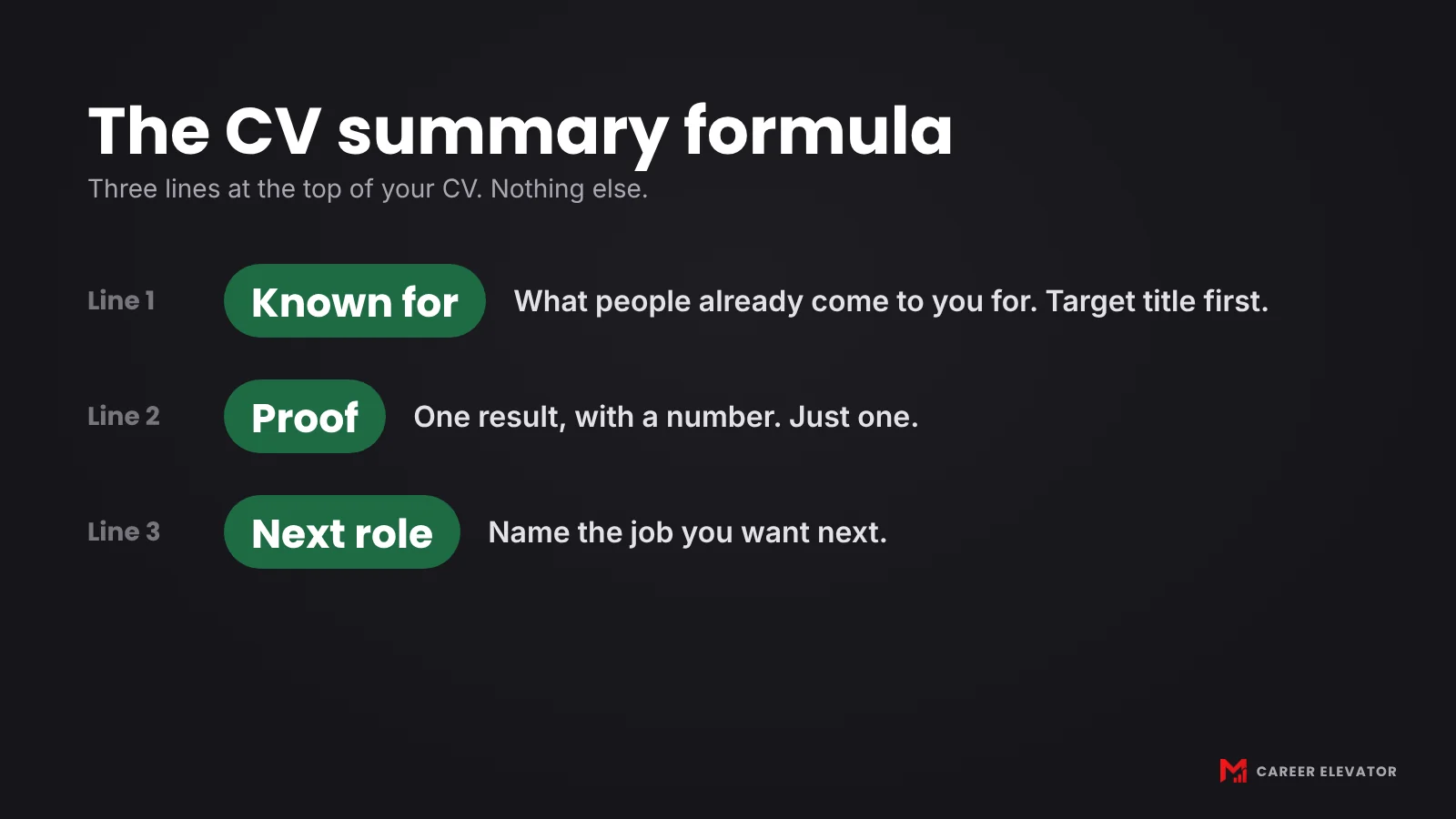
1. Known for
What do people already come to you for? Start with your target title or level, then the problem you're known for solving. "Operations Director known for making multi-site distribution leaner and more reliable."
2. Proof
One concrete result, with a number. Just one. A single, specific result is easier to believe than a list of five. "Merged three Midlands warehouses into one, cutting freight costs by £3.1m a year."
3. Next role
Name the job you want. "Ready to step up as Group Operations Director." This line tells the reader exactly where you fit.
Keep the whole thing to three or four lines on the page. If it runs longer, you're probably listing duties again.
CV personal statement examples: 3 before-and-after rewrites
In each example, Max (Career Elevator's career coach) reads the summary and says in one line what's wrong. He then asks the person one question and rewrites the summary from their answer. All three people are made up for illustration.
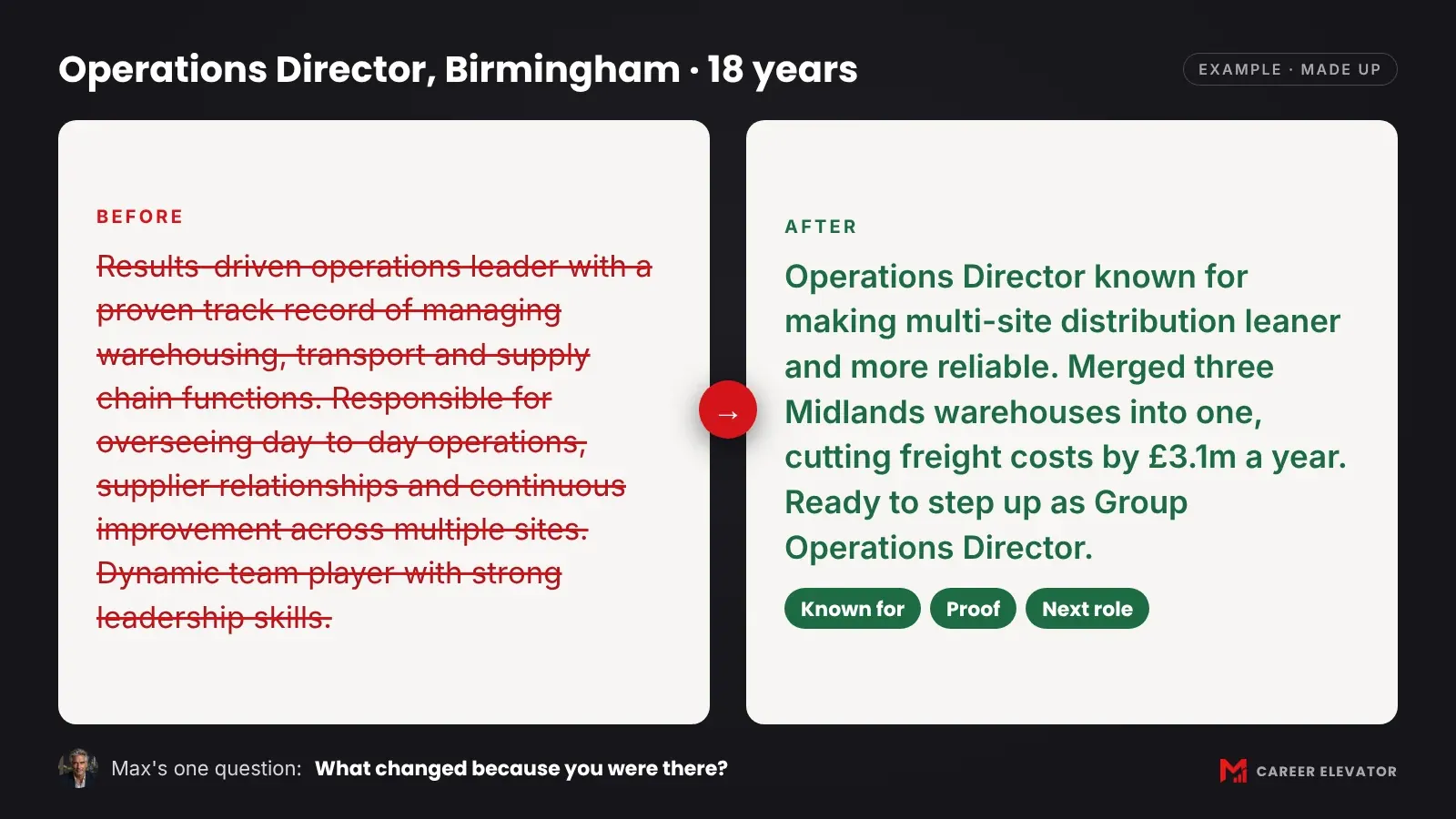
Example 1: Operations Director, Birmingham (18 years)
Before:
Results-driven operations leader with a proven track record of managing warehousing, transport and supply chain functions. Responsible for overseeing day-to-day operations, supplier relationships and continuous improvement across multiple sites. Dynamic team player with strong leadership skills.
What's wrong: It reads like a job description. Eighteen years, not one number, and no target role.
Max's one question: "What changed because you were there?"
The answer: "We merged 3 Midlands warehouses into 1. Freight costs down £3.1m a year."
After:
Operations Director known for making multi-site distribution leaner and more reliable. Merged three Midlands warehouses into one, cutting freight costs by £3.1m a year. Ready to step up as Group Operations Director.
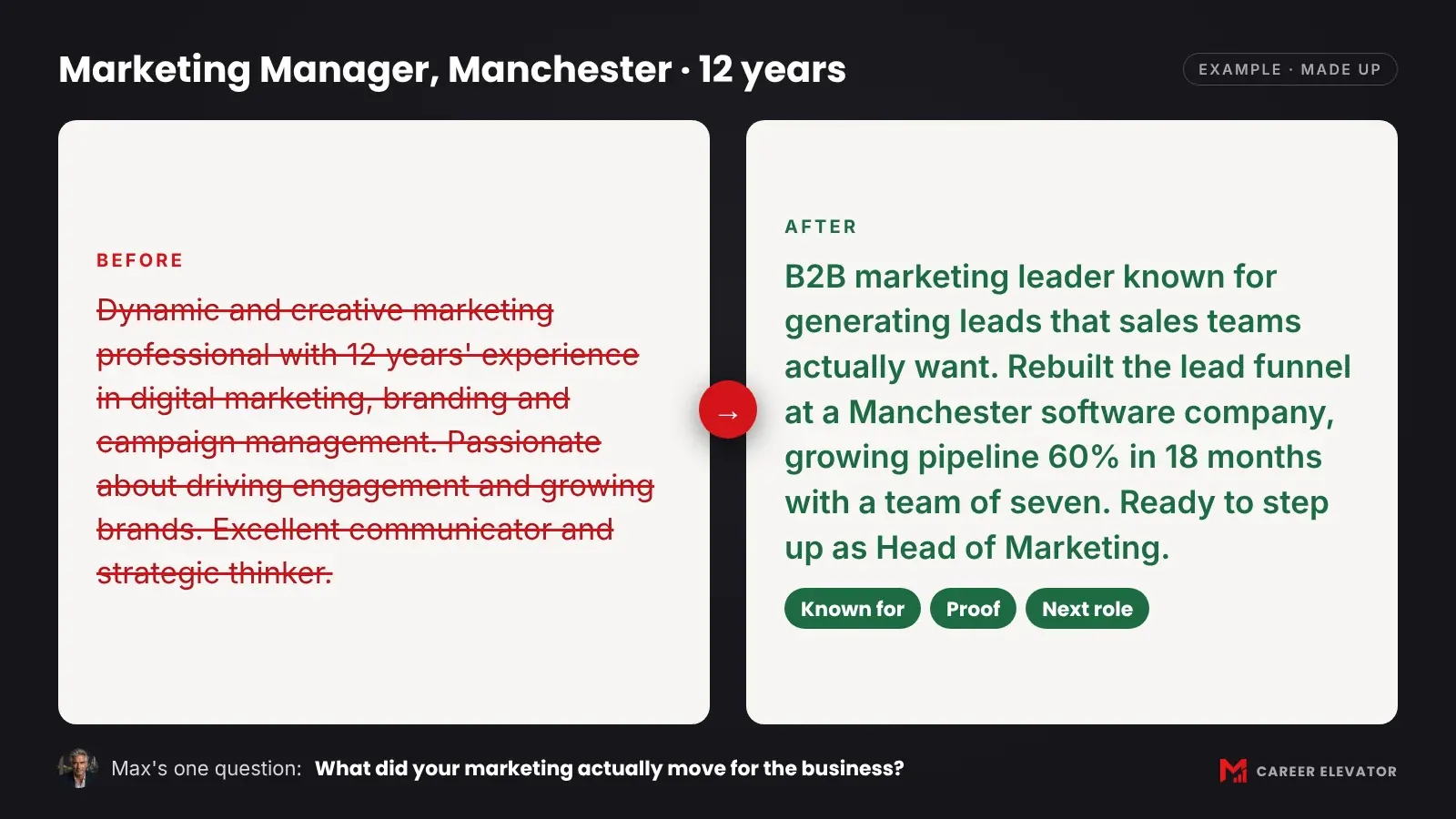
Example 2: Marketing Manager moving up to Head of Marketing, Manchester (12 years)
Before:
Dynamic and creative marketing professional with 12 years' experience in digital marketing, branding and campaign management. Passionate about driving engagement and growing brands. Excellent communicator and strategic thinker.
What's wrong: Every applicant is "passionate". Nothing here says she's ready to run the whole marketing function.
Max's one question: "What did your marketing actually move for the business?"
The answer: "I rebuilt our B2B lead funnel. Pipeline up 60% in 18 months. I lead a team of 7."
After:
B2B marketing leader known for generating leads that sales teams actually want. Rebuilt the lead funnel at a Manchester software company, growing pipeline 60% in 18 months with a team of seven. Ready to step up as Head of Marketing.
Look at "with a team of seven". Those few words show she leads people, not just campaigns, which is exactly what a Head of Marketing hire needs to see.
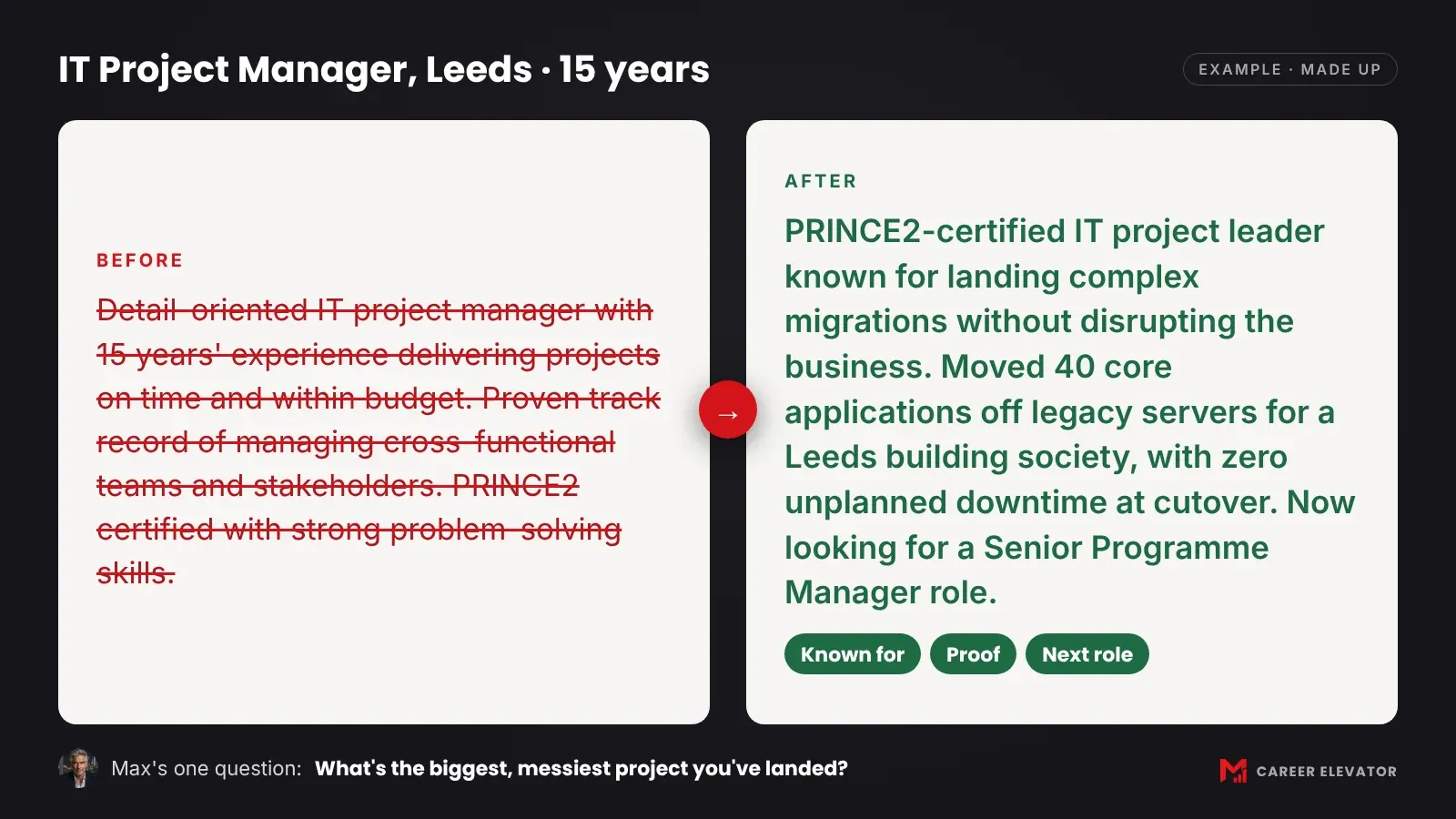
Example 3: IT Project Manager, Leeds (15 years)
Before:
Detail-oriented IT project manager with 15 years' experience delivering projects on time and within budget. Proven track record of managing cross-functional teams and stakeholders. PRINCE2 certified with strong problem-solving skills.
What's wrong: "On time and within budget" is the minimum anyone expects. Which projects? How big?
Max's one question: "What's the biggest, messiest project you've landed?"
The answer: "Moved 40 core systems off legacy servers for a Leeds building society. Zero unplanned downtime at cutover."
After:
PRINCE2-certified IT project leader known for landing complex migrations without disrupting the business. Moved 40 core applications off legacy servers for a Leeds building society, with zero unplanned downtime at cutover. Now looking for a Senior Programme Manager role.
One project, told properly, says more than fifteen years of "on time and within budget".
More CV summary examples by level
The formula works at every level. Here are four shorter examples. The people and companies are made up.
Senior specialist: Senior Financial Analyst, Bristol
Senior Financial Analyst known for turning messy data into forecasts the board actually uses. Built a rolling forecast model that cut the month-end review from five days to two. Looking to move into an FP&A Manager role.
Manager: Customer Success Manager, Glasgow
Customer Success Manager known for rescuing at-risk enterprise accounts. Led a renewal programme at Strathmoray Software that brought 14 of 16 flagged accounts back to renewal in a year. Ready to lead a customer success team.
Director: HR Director, Cardiff
HR Director known for building people programmes in fast-growing, multi-site organisations. Designed the onboarding and manager training at Wenlowe Housing Group that supported growth from 300 to 900 staff in three years. Now looking for a Chief People Officer role.
Executive: Sales Director, London
Commercial leader known for building repeatable B2B sales teams from scratch. Grew a UK sales team from 6 to 40 people and annual bookings from £9m to £36m in four years. Ready for a Chief Commercial Officer role.
How to find your proof when you can't think of a number
If the Proof line has you stuck, you're in good company. Experienced people tend to remember what they were responsible for rather than what they changed. Try the kind of questions Max asks:
- What changed because you were there?
- What was broken when you arrived, and what was it like when you left?
- What's the biggest, messiest project you've landed?
- What did your work move for the business: revenue, cost, time, risk, retention?
- If your old manager described your best year, what would they mention first?
Your number doesn't have to be huge. It has to be true, specific and yours. Time saved, a team built, costs cut or a project delivered all count. If you can't share exact figures, use an honest range or a sense of scale ("a 40-person team", "five sites", "three countries").
CV summary checklist
Before you save, check that your summary:
- Opens with your target title or level
- Says what you're known for in plain English
- Includes one concrete result with a number
- Names the next role you want
- Runs to three or four lines, no more
- Avoids results-driven, dynamic, passionate, proven track record, detail-oriented and team player
- Uses UK spelling throughout
- Sounds like you, not like anyone else in your job
FAQ
How long should a CV personal statement be?
For most experienced professionals, three or four lines on the page, which is usually two or three sentences. That's enough for Known for, Proof and Next role, and short enough to read at a glance.
Is a CV summary the same as a personal statement?
Yes. CV summary, personal statement and personal profile all mean the short paragraph at the top of your CV. Some people use "personal statement" for graduate CVs and university applications, but on an experienced professional's CV the job is the same: say who you are, prove it, and name the next role.
Should I write my personal statement in the first person?
Either works if you're consistent. Many UK CVs use an implied first person, with no "I", no "he" and no "she". Starting with your title ("Operations Director known for…") keeps it crisp and avoids a paragraph full of "I".
Should I change my CV summary for every job?
Keep the core, meaning what you're known for and your strongest proof. Then adjust the details so they match the role you're applying for: the job title in the Next role line, and which result you lead with.
Want Max to look at yours?
Reading examples helps. Having someone look at your summary helps more. Take your Free Career Audit and let Max have a look.
All people, CVs and companies in this article are made up for illustration.