Career Elevator guide
Resume Summary Examples: How to Write One That Works
Resume summary examples for experienced professionals, plus a simple formula: Known for, Proof, Next role. See 3 senior before-and-after rewrites.
In this article
- What a resume summary is (and what it's for)
- Why most resume summaries fail
- The formula: Known for + Proof + Next role
- Resume summary examples: 3 before-and-after rewrites
- More resume summary examples by seniority
- How to find your proof (when you can't think of a number)
- Resume summary checklist
- FAQ
- Want Max to look at yours?
Your resume summary is the first thing a reader sees on your resume. For a lot of experienced professionals, it's also where they stop reading.
The reason isn't a lack of experience. After 12, 15 or 20 years, you have plenty to say. The problem is that the summary usually gets written last, in a hurry. So it turns into a list of duties wrapped in buzzwords: results-driven, dynamic, proven track record. Those words could describe anyone, so they end up describing no one.
This guide gives you a simple three-part formula, three senior before-and-after examples, more short examples by seniority, and a quick checklist you can use today.
What a resume summary is (and what it's for)
A resume summary, sometimes called a professional summary, is the short paragraph at the top of your resume, under your name and contact details. For an experienced professional it should do one job: tell the reader who you are at work, prove it, and point at the role you want next.
It is not a list of every skill you have. It is not your job description. And it is not an objective statement about what you hope to gain. Think of it as the two or three lines you'd want a hiring manager to remember if they read nothing else.
Why most resume summaries fail
They list duties instead of results
"Responsible for overseeing daily operations, vendor relationships and process improvement" tells the reader what you were in charge of. It doesn't say what you're good at, or what changed because you were there. Anyone in the same job could have written the same line.
They lean on buzzwords
Results-driven. Dynamic. Passionate. Detail-oriented. Strategic thinker. Excellent communicator. These words feel safe, which is exactly the problem: they're on so many resumes that the reader skims straight past them. If a word could appear on every applicant's resume, it isn't doing any work on yours.
They don't name the next role
Many senior summaries describe the past and say nothing about the future. If you're a marketing manager going for Head of Marketing, and your summary never says "Head of Marketing", you're asking the reader to guess. Most won't.
The formula: Known for + Proof + Next role
Every strong summary in this guide follows the same three keys.
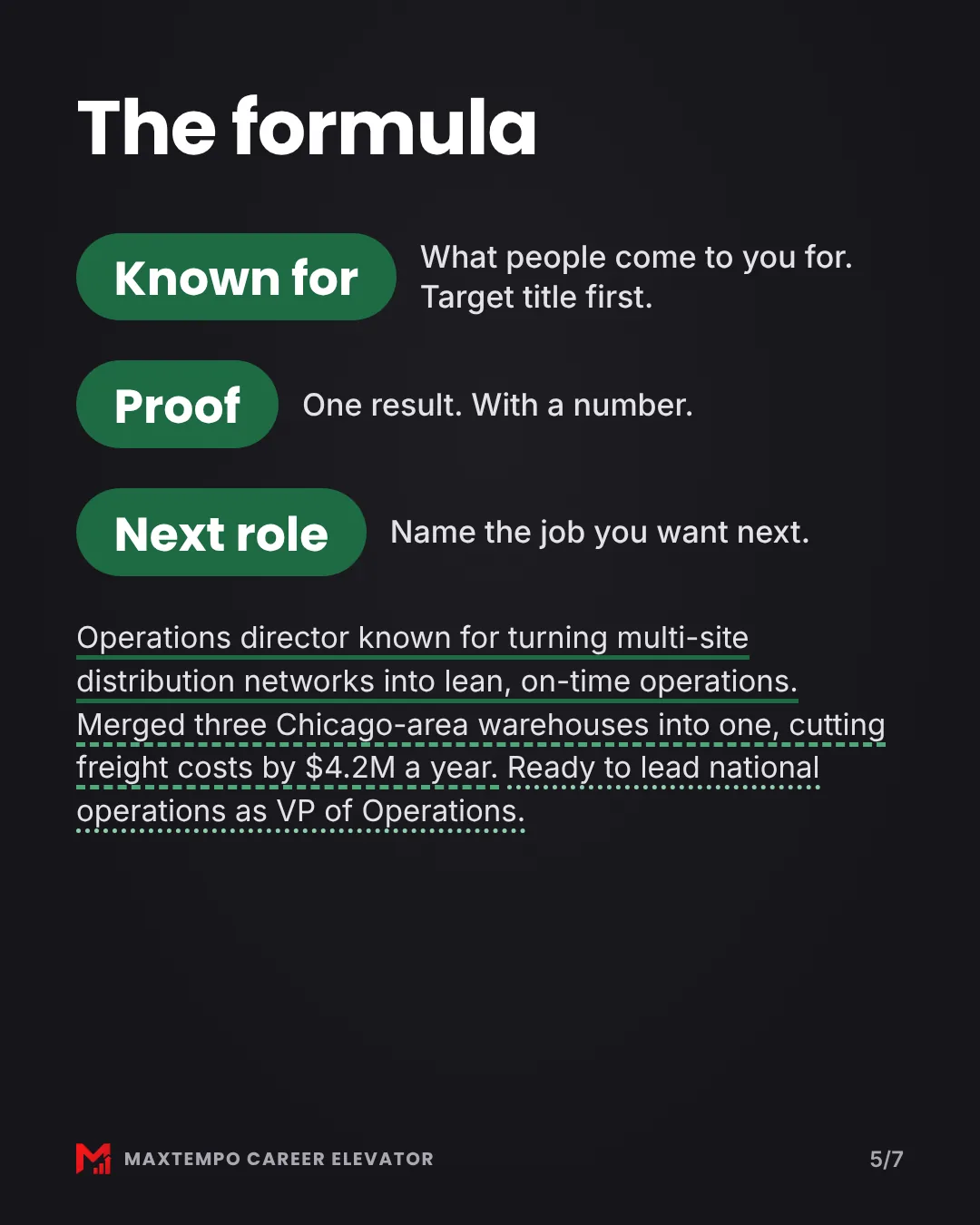
1. Known for
What do people already come to you for? Start with your target title or level, then the problem you're known for solving. "Operations director known for turning multi-site distribution networks into lean, on-time operations."
2. Proof
One concrete result, with a number. One, not five. A single, specific result is more believable than a list. "Merged three Chicago-area warehouses into one, cutting freight costs by $4.2M a year."
3. Next role
Name the job you want. "Ready to lead national operations as VP of Operations." This line tells the reader exactly where to place you.
Keep the whole thing to two or three sentences. If it runs longer, you're probably listing duties again.
Resume summary examples: 3 before-and-after rewrites
In each example below, Max (Career Elevator's career coach) reads the summary, says what's wrong in one line, asks the person one question, and rewrites the summary from the answer. All three people are made up for illustration.
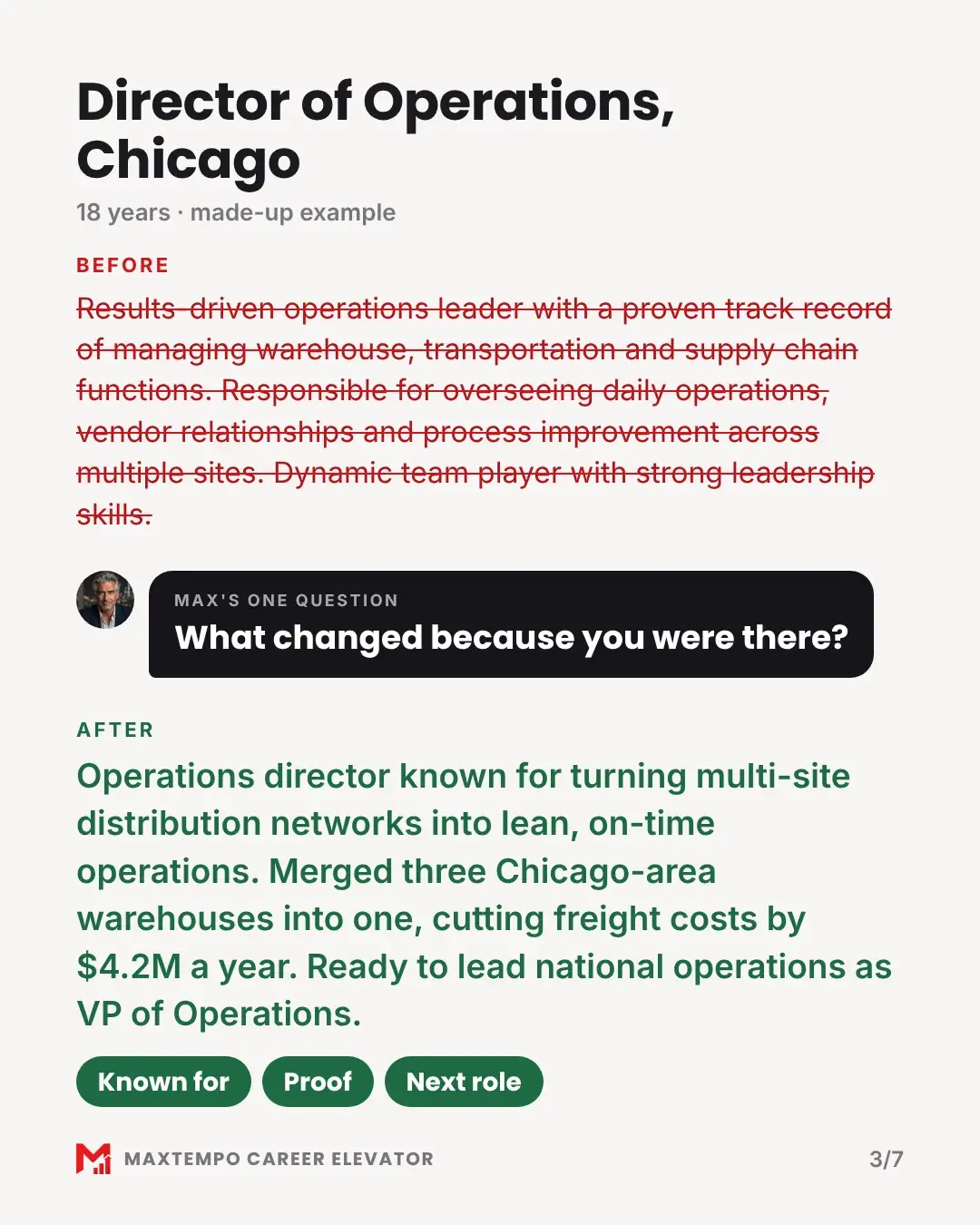
Example 1: Director of Operations, Chicago (18 years)
Before:
Results-driven operations leader with a proven track record of managing warehouse, transportation and supply chain functions. Responsible for overseeing daily operations, vendor relationships and process improvement across multiple sites. Dynamic team player with strong leadership skills.
What's wrong: It's a job description. Eighteen years, not one number, and no target role.
Max's one question: "What changed because you were there?"
The answer: "We merged 3 Chicago-area warehouses into 1. Freight costs down $4.2M a year."
After:
Operations director known for turning multi-site distribution networks into lean, on-time operations. Merged three Chicago-area warehouses into one, cutting freight costs by $4.2M a year. Ready to lead national operations as VP of Operations.
Example 2: Marketing Manager moving up to Head of Marketing, Austin (12 years)
Before:
Dynamic and creative marketing professional with 12 years of experience in digital marketing, branding and campaign management. Passionate about driving engagement and growing brands. Excellent communicator and strategic thinker.
What's wrong: Every applicant is "passionate". Nothing here says she's ready to run the whole marketing function.
Max's one question: "What did your marketing actually move for the business?"
The answer: "I rebuilt our B2B lead funnel. Pipeline up 60% in 18 months. I lead a team of 7."
After:
B2B marketing leader known for building demand engines that sales teams trust. Rebuilt the lead funnel at an Austin SaaS company, growing pipeline 60% in 18 months with a team of seven. Ready to step up as Head of Marketing.
Notice "with a team of seven". That short phrase shows she can lead people, not just run campaigns, which is exactly what a Head of Marketing hire needs to see.
Example 3: IT Project Manager, Toronto (15 years)
Before:
Detail-oriented IT project manager with 15 years of experience delivering projects on time and on budget. Proven track record of managing cross-functional teams and stakeholders. PMP certified with strong problem-solving skills.
What's wrong: "On time and on budget" is the minimum expectation for the job. Which projects? How big?
Max's one question: "What's the biggest, messiest project you've landed?"
The answer: "Moved 40 core apps to the cloud for a Toronto credit union. Zero unplanned downtime at cutover."
After:
PMP-certified IT project leader known for landing complex cloud migrations without disrupting the business. Moved 40 core applications to the cloud for a Toronto credit union with zero unplanned downtime at cutover. Ready for a Senior Program Manager role.
One project, told properly, says more than fifteen years of "on time and on budget".
More resume summary examples by seniority
The same formula works at every level. Here are four more short examples (all made up).
Senior specialist: Senior Financial Analyst, Charlotte
Senior financial analyst known for turning messy data into forecasts leadership actually uses. Built a rolling forecast model that cut the monthly close review from five days to two. Looking to move into an FP&A Manager role.
Manager: Customer Success Manager, Denver
Customer success manager known for rescuing at-risk enterprise accounts. Led a renewal program that brought 14 of 16 flagged accounts back to renewal in one year. Ready to lead a customer success team as Senior Manager.
Director: Director of Human Resources, Minneapolis
HR director known for building people programs in fast-growing, multi-state companies. Designed the onboarding and manager training that supported growth from 300 to 900 employees in three years. Seeking a VP of People role.
Executive: VP of Sales, Atlanta
Sales executive known for building repeatable B2B sales teams from the ground up. Grew a regional team from 6 to 40 reps and annual bookings from $12M to $48M in four years. Ready for a Chief Revenue Officer role.
How to find your proof (when you can't think of a number)
If you're stuck on the Proof line, you're not alone. Experienced people often remember what they were responsible for, not what they changed. Try these prompts, the same kind of question Max asks:
- What changed because you were there?
- What was broken when you arrived, and what was it like when you left?
- What's the biggest, messiest project you've landed?
- What did your work move for the business: revenue, cost, time, risk, retention?
- If your old boss described your best year, what would they mention first?
Your number doesn't have to be huge. It has to be true, specific and yours. A time saved, a team built, a cost cut or a project delivered all count. If you can't share exact figures, use a fair, honest range or a scale marker ("a 40-person team", "five sites", "three countries").
Resume summary checklist
Before you hit save, check that your summary:
- Starts with your target title or level
- Says what you're known for in plain words
- Includes one concrete result with a number
- Names the next role you want
- Is two or three sentences long
- Contains none of: results-driven, dynamic, passionate, proven track record, detail-oriented, team player
- Reads like you, not like anyone in your job
FAQ
How long should a resume summary be?
For most experienced professionals, two or three sentences, roughly three to five lines on the page. Long enough to cover Known for, Proof and Next role; short enough to read in one glance.
What's the difference between a resume summary and a resume objective?
An objective says what you want. A summary says what you offer, and then what you want next. For experienced professionals, a summary is usually the stronger choice because it leads with your value. The Next role line covers the "objective" part in one sentence.
Should I write my resume summary in the first person?
The usual convention is an "implied first person": no "I", no "he" or "she". Start with your title or a strong phrase ("Operations director known for…") and keep it crisp.
Should I change my summary for every job?
Keep the core (what you're known for and your strongest proof) and adjust the details: the target title in the Next role line, and which result you lead with, so it matches the role you're applying for.
Want Max to look at yours?
Reading examples helps. Having someone look at your summary helps more. Take your Free Career Audit and let Max take a look.
All people, resumes and companies in this article are made up for illustration.