Career Elevator guide
STAR Method for Interviews: Examples That Actually Work
What is the STAR method? Situation, Task, Action, Result. How to use it in interviews, STAR method examples and the questions to prepare for.
In this article
You've done the work. You just can't tell the story in two minutes.
That's the honest problem for most experienced people in interviews. It isn't a lack of material. After 10, 15 or 20 years you have more stories than you need. The trouble is how they come out: four minutes of background, a lot of "we", and an ending that trails off before anyone hears what changed.
The STAR method fixes that. This guide explains what it is, how to use it, three STAR method examples rewritten from weak answers, and the interview questions you should prepare for.
What is the STAR method?
The STAR method is a way to answer behavioral interview questions in four parts: Situation, Task, Action and Result. Interviewers use behavioral questions, the "tell me about a time when…" kind, to hear how you've handled real situations. STAR gives your answer a shape so the interviewer can follow it.
How the STAR interview method works
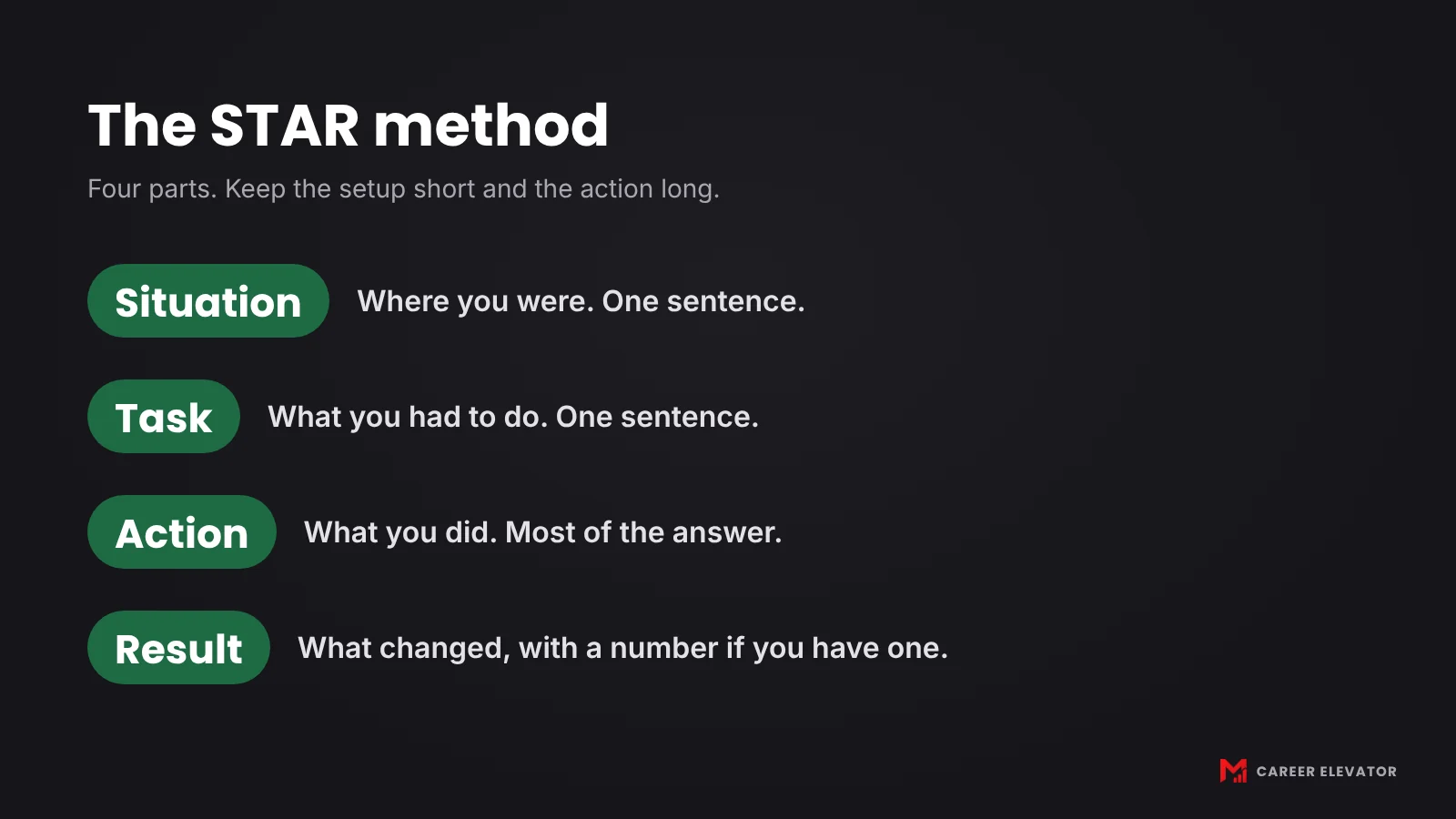
- Situation: where you were. One sentence of context.
- Task: what you had to do, or the problem you owned.
- Action: what you did. This should be most of your answer.
- Result: what changed because of it, with a number if you have one.
A simple way to remember the balance: keep the setup short, make the action long, and always land the result.
Why experienced people's interview answers go wrong
Senior candidates tend to make the same three mistakes when they answer with the STAR method in an interview:
- Too much situation. The background is interesting to you because you lived it. The interviewer only needs enough to follow the story.
- "We" instead of "I". Good leaders give credit to their teams, which is right in most settings. In an interview it hides the one thing they need to know: what you did.
- No result. The story stops at the action, or ends with "and it went well". Without a result, the interviewer has to guess whether it worked.
STAR method examples
Each example below was rewritten after one question from Max, Career Elevator's career coach. The people are made up for illustration.
Example 1: "Tell me about a time you influenced without authority"
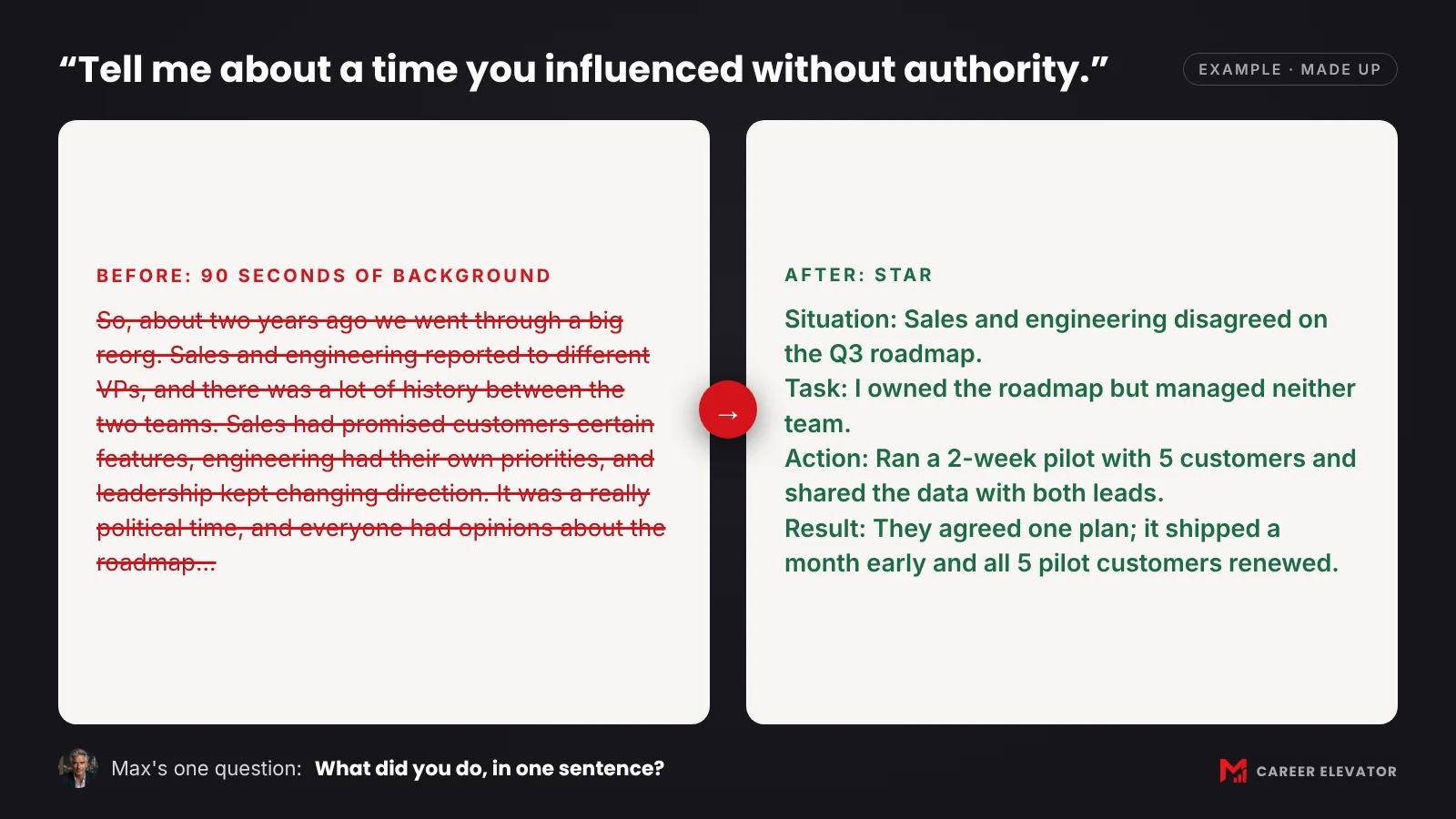
Rachel, a senior product manager with 12 years' experience, spent her first 90 seconds on the reorganization, the two teams and the history between them.
Max's one question: "What did you do, in one sentence?"
Her STAR answer:
- Situation: Sales and engineering disagreed on the Q3 roadmap.
- Task: I owned the roadmap but managed neither team.
- Action: I ran a two-week pilot with five customers and shared the data with both leads.
- Result: They agreed one plan. It shipped a month early, and all five pilot customers renewed.
Example 2: "Tell me about a time you failed"
Marcus, a plant manager with 19 years' experience, said: "We had a launch that went badly. The team struggled. We learned a lot."
Max's one question: "What was your call, and what changed after?"
His STAR answer:
- Situation: We were launching a new product line against a tight date.
- Task: It was my decision how fast to change over the line.
- Action: I rushed it and lost two days of output. I owned that with my director, then made a pilot shift mandatory before any changeover.
- Result: The next four changeovers ran with no lost output.
A good failure answer has the same shape as any other STAR story. The difference is that the action includes owning the mistake, and the result shows what you changed.
Example 3: the story that starts on your resume
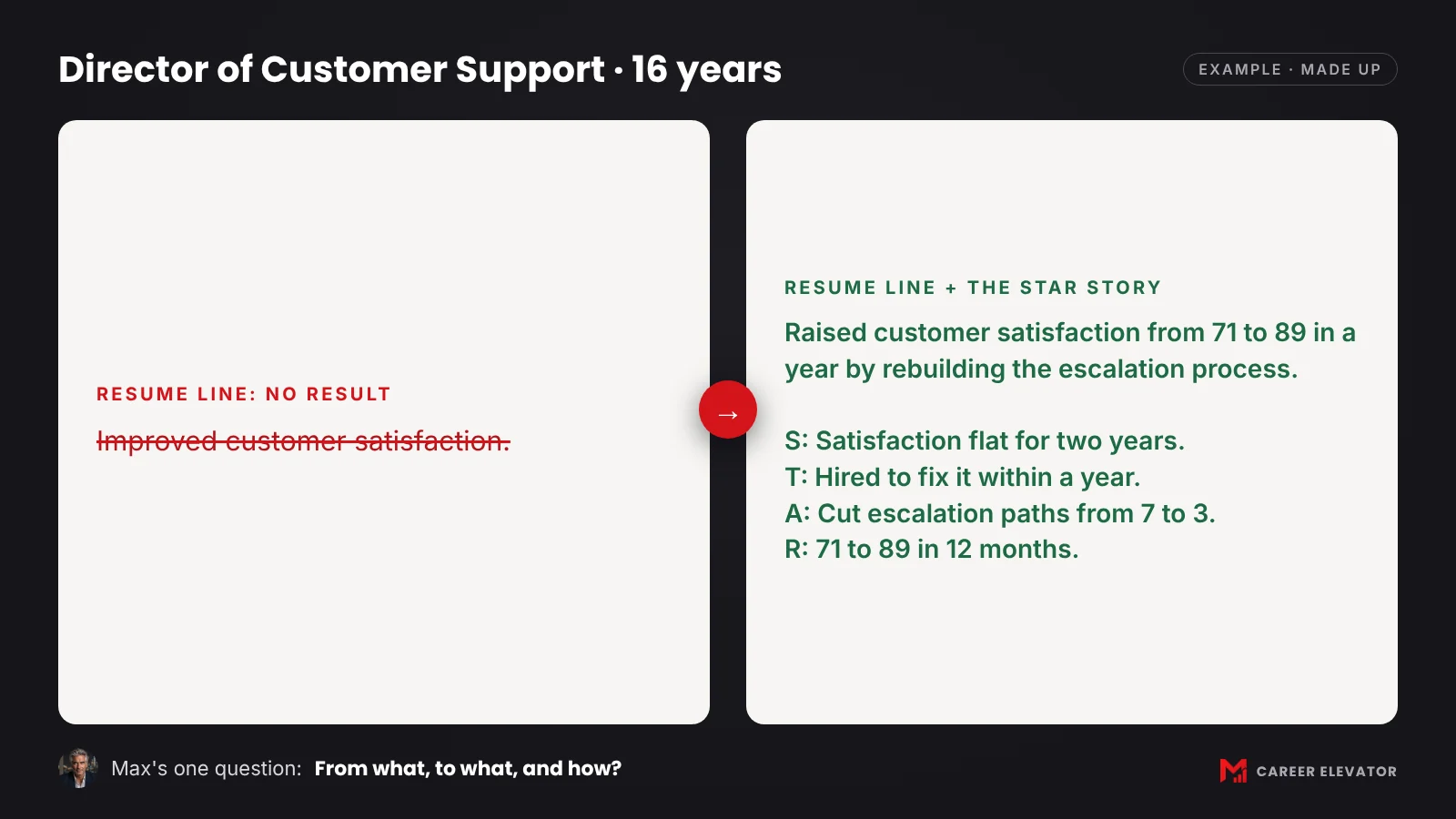
Elena, a director of customer support with 16 years' experience, had this line on her resume:
Improved customer satisfaction.
That line can't become a story, because it has no result.
Max's one question: "From what, to what, and how?"
The rewritten resume line:
Raised customer satisfaction from 71 to 89 in a year by rebuilding the escalation process.
And the STAR story behind it:
- Situation: Satisfaction scores had been flat for two years and escalations were piling up.
- Task: I was hired to fix it within a year.
- Action: I mapped every escalation path, cut them from seven to three, and gave frontline agents authority to resolve refunds up to a set limit.
- Result: Satisfaction went from 71 to 89 in twelve months.
This is where most good STAR stories come from: a resume line with a real result in it. If the line is vague, the story will be too.
STAR method interview questions to prepare for
These come up often in behavioral interviews. Have a STAR story ready for each:
- Tell me about a time you disagreed with your manager.
- Tell me about a time you failed.
- Tell me about a time you led a change that people resisted.
- Tell me about a time you made a decision without all the information.
- Tell me about a time you dealt with a difficult stakeholder.
- Tell me about a time you had to deliver bad news.
- Tell me about your proudest achievement.
You don't need a separate story for every possible question. Six to eight strong stories, each with a clear result, can be adapted to cover most of them. For the other common questions, and what each one is really asking, see our guide to interview questions and answers.
How long should a STAR answer be?
A common guideline is about two minutes per answer. If you're going over three, the situation is almost always too long. Cut the background to a sentence and let the interviewer ask for more if they want it.
How to prepare your STAR stories
- Go through your resume and pick the six to eight lines with the strongest results.
- For each line, write one sentence each for situation and task, three or four for action, and one for the result.
- Read each one out loud and time it.
- Check every story for "we". Change it to "I" wherever it was your call.
- Make sure each story ends on a result you can say in one breath.
If you can't find six lines with real results on your resume, that's the place to start. The interview story can only be as specific as the line it comes from.
FAQ
What is the STAR method?
The STAR method is a way to answer behavioral interview questions in four parts: Situation, Task, Action and Result. You set the scene briefly, say what you had to do, explain what you did, and finish with what changed.
What does STAR stand for?
Situation, Task, Action, Result.
How long should a STAR answer be?
A common guideline is about two minutes. Keep the situation and task to a sentence or two, spend most of the time on your actions, and end on a clear result.
Can I use the STAR method for "Tell me about yourself"?
Not really. STAR is built for "tell me about a time" questions. For "tell me about yourself", a short present, past and future answer works better.
What if my result doesn't have a number?
Use the most specific outcome you can: a decision that got made, a deadline that was met, a problem that stopped recurring, or what someone said about the result. A clear outcome without a number beats a vague one.
Your STAR stories start on your resume
The Free Career Audit isn't interview coaching, but it works on the part your stories come from. In your Free Career Audit, Max asks what you want next, finds the one vague line on your resume, asks you one sharp question about it, and rewrites that line with you. Get the result into that line, and you have the start of a STAR story.
All people and companies in this article are made up for illustration.