Career Elevator guide
How Long Should a CV Be? The Honest UK Answer
How long should a CV be in the UK? Two pages for most people. Plus how long your personal statement and bullet points should be, with UK examples.
In this article
- How long should a CV be?
- How long should a CV be in the UK compared with the US?
- How long should a CV be with 20 years' experience?
- How long should a CV personal statement be?
- How long should bullet points be on a CV?
- What to leave off a UK CV
- Three examples: shorter and stronger
- CV length checklist
- FAQ
- Want Max to look at yours?
Twenty years in. Three pages of CV. Nobody's reading page three.
That isn't a criticism of your career. It's how CVs get read. A hiring manager starts at the top of page one, and if that page doesn't make the case, the rest rarely gets a proper look. Most long CVs aren't long because someone has done too much. They're long because nothing ever got taken out.
This guide covers how long a UK CV should be, how long your personal statement and bullet points should be, what to leave off, and three examples of CVs that got shorter and stronger.
How long should a CV be?
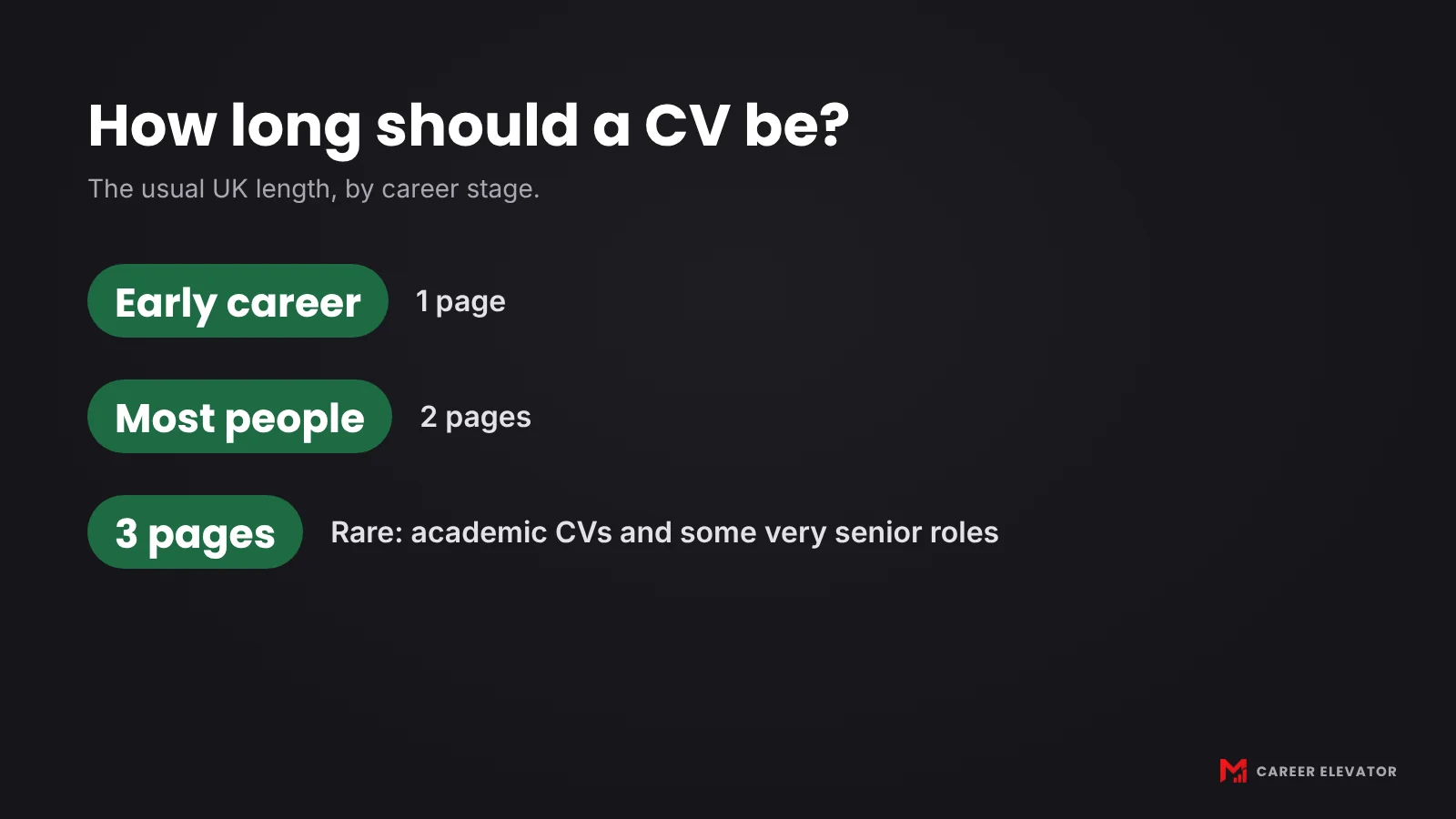
A CV should be two pages long for most people in the UK. That's the length recruiters here are used to, and it gives an experienced professional enough room without padding.
A graduate or someone early in their career may only need one page. A third page is unusual and mostly limited to academic CVs, where publications and research take up space, and some very senior or technical roles. For everyone else, two pages is the ceiling. If you can make your case in a page and a half, that's fine too.
How long should a CV be in the UK compared with the US?
UK CVs are usually two pages, while American advice often pushes for a single page. If you've been reading US guides, that's why the advice doesn't match.
A few other UK conventions also affect length:
- No photo. UK CVs normally leave photos out.
- No date of birth, age, marital status or nationality. None of these belong on a UK CV, and leaving them off saves space.
- A personal statement at the top. Also called a personal profile, it sits under your name and contact details.
- UK spelling throughout. Organisation, programme, analyse.
How long should a CV be with 20 years' experience?
Still two pages. Twenty years of experience doesn't need more space. It needs you to stop giving every year the same amount of it.
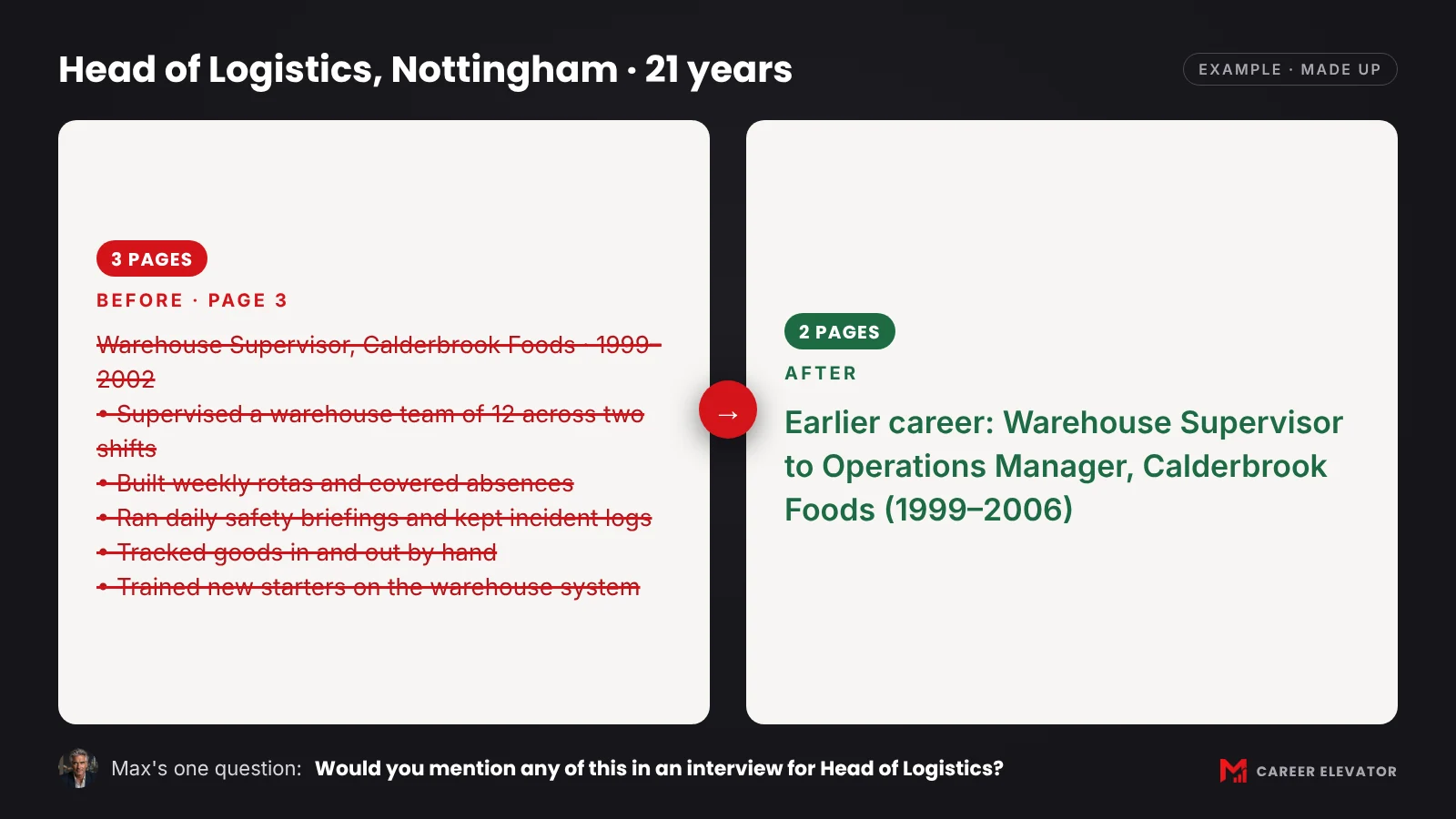
Keep full detail for your last 10 to 15 years and condense everything older. A role from 1999 doesn't need five bullet points. One line does the job:
Earlier career: Warehouse Supervisor to Operations Manager, Calderbrook Foods (1999–2006)
That tells the reader where you started without spending half a page on it. A simple test: if you wouldn't bring it up in an interview for the job you want now, it doesn't need to be there.
How long should a CV personal statement be?
A CV personal statement should be four to six lines, which usually means three or four sentences. Any longer and it turns into a second CV sitting on top of the first.
The same answer applies to a personal profile, which is just another name for the same section. Short is fine as long as it covers three things:
- Known for: what people already come to you for, starting with the title you want
- Proof: one result, with a number
- Next role: the job you want next
Our CV summary guide has full before-and-after examples.
How long should a personal profile be on a CV?
Four to six lines, exactly like a personal statement. If yours fills a third of page one, cut it back to the three parts above.
How long should bullet points be on a CV?
Each bullet point should run to one or two lines. When a bullet spills onto three or four, the result usually ends up buried at the end, where plenty of readers never get to it.
Lead with what you did and what changed. Three to six bullets per recent role is plenty. Our CV tips guide shows a simple formula for writing them, with examples.
What to leave off a UK CV
If your CV is running long, start here:
- A photo, date of birth or marital status. Standard UK practice is to leave them out.
- "References available on request." Employers assume it.
- Your full postal address. Town or city is enough.
- An objective statement. Replace it with a personal statement that says what you offer.
- Detailed bullets for old roles. Condense anything older than about 15 years.
- Every piece of software you've used. Keep what the job description asks for.
Three examples: shorter and stronger
Each example was rewritten after one question from Max, the AI career coach at Maxtempo Career Elevator. All three people are made up for illustration.
Example 1: Head of Logistics, Nottingham, 21 years, three pages
Page three of Gareth's CV was nothing but roles from 1999 to 2006, each with five bullets.
Max's one question: "Would you mention any of this in an interview for Head of Logistics?"
His answer: "Honestly, no."
The fix: everything before 2006 became a single Earlier career line, and the CV came down to two pages with his current role leading page one.
Example 2: Finance Director, Bristol, 16 years, a nine-line personal statement
Before: nine lines listing every system, team and qualification.
Max's one question: "If they remember one thing about you, what should it be?"
Her answer: "I got month-end close down from 10 days to 4."
After:
Finance Director known for fast, clean month-end closes. Cut the close from 10 days to 4 across three entities. Ready for a Group Finance Director role.
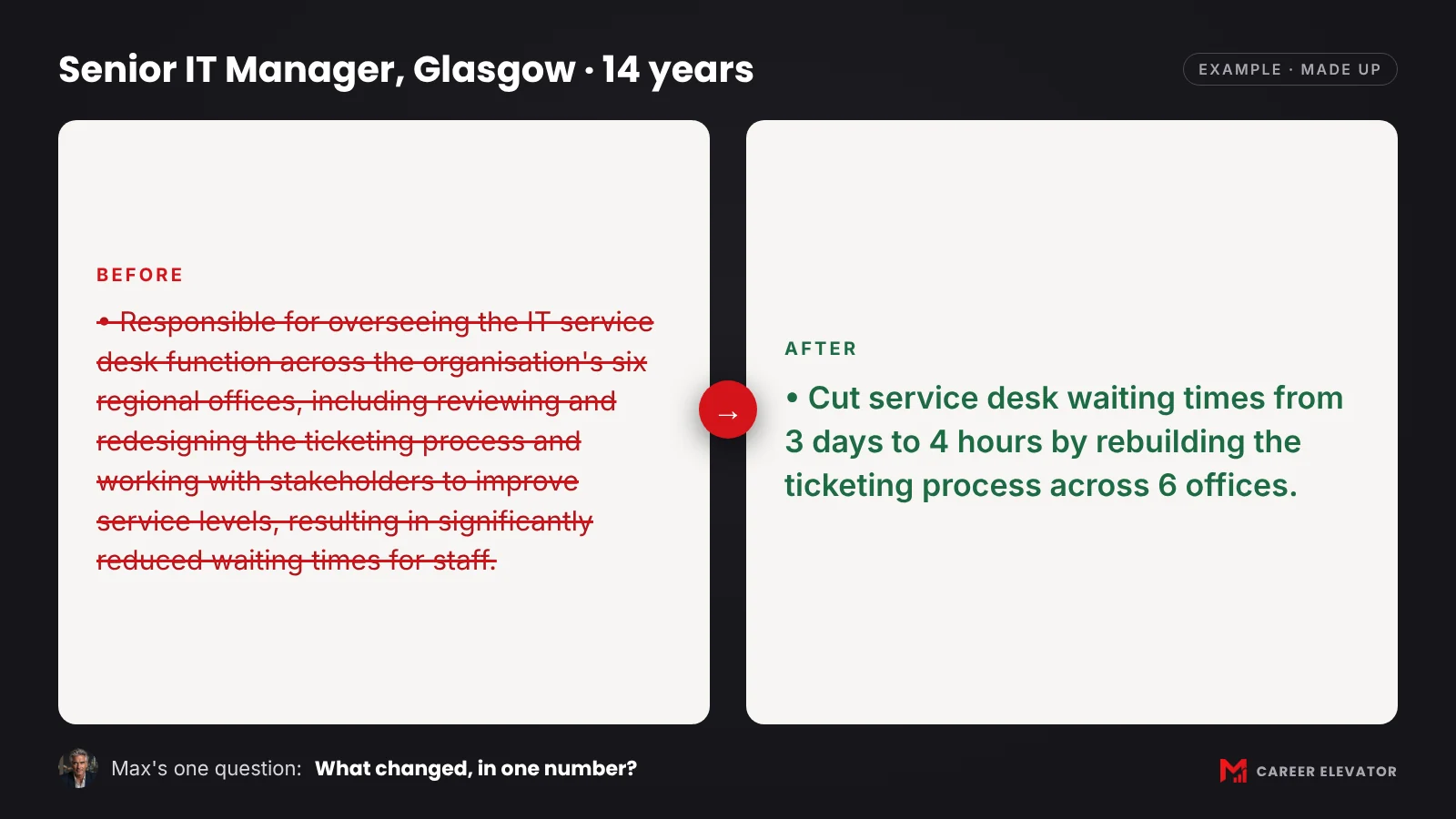
Example 3: Senior IT Manager, Glasgow, 14 years, four-line bullets
Before:
Responsible for overseeing the IT service desk function across the organisation's six regional offices, including reviewing and redesigning the ticketing process and working with stakeholders to improve service levels, resulting in significantly reduced waiting times for staff.
Max's one question: "What changed, in one number?"
After:
Cut service desk waiting times from 3 days to 4 hours by rebuilding the ticketing process across 6 offices.
CV length checklist
Before you send it, check that your CV:
- Fits on two pages (one if you're early in your career)
- Puts your strongest, most relevant work on page one
- Has a personal statement of four to six lines
- Keeps bullet points to one or two lines, result first
- Gives full detail only to your last 10 to 15 years
- Leaves out a photo, date of birth and "references available on request"
- Uses UK spelling throughout
FAQ
How long should a CV be in the UK?
Two pages is the standard length for most UK CVs. A graduate may only need one, and a third page is usually reserved for academic CVs and some very senior roles.
Is a three-page CV ever acceptable?
Sometimes. Academic CVs with publications, and some board-level or highly technical roles, can justify a third page. For most experienced professionals, two pages is the sensible ceiling.
How long should a personal profile be on a CV?
Four to six lines, usually three or four sentences. That's long enough to say what you're known for, give one result and name the role you want next.
Should a graduate CV be one page?
It can be. Early in your career, one strong page beats two thin ones. Move to two pages once you have the experience to fill them properly.
Do I need to include every job on my CV?
No. Give your last 10 to 15 years in detail and condense anything older into one line per role, or a single Earlier career line.
Want Max to look at yours?
Cutting length is the easy part. Spotting the line that's holding you back is harder. In your Free Career Audit, Max asks what you want next, finds the one vague line on your CV, asks you one sharp question about it, and rewrites that line with you.
All people, CVs and companies in this article are made up for illustration.