Career Elevator guide
How Long Should a Resume Be? The Honest Answer for 2026
How long should a resume be? One page early on, two pages with 10+ years. Plus how long your summary and bullet points should be, with examples.
In this article
Twenty years of experience. Three pages of resume. Nobody's reading page three.
That's not a dig at your career. It's how resumes get read. A hiring manager starts at the top of page one, and if page one doesn't make the case, the rest rarely gets a fair look. Length on its own isn't the problem. Old detail is. Most long resumes are long because nothing ever got taken out.
This guide gives you the straight answer on resume length, how long your summary and bullet points should be, what to cut first, and three examples of resumes that got shorter and stronger.
How long should a resume be?
A resume should be one page early in your career and two pages once you have about ten years of experience or more. That's the length most recruiters expect.
Three pages is rare. It's mostly for some senior executive roles and academic CVs, where publications and grants run long. For almost everyone else, two pages is the ceiling, not the target. If you can make your case well in a page and a half, do that.
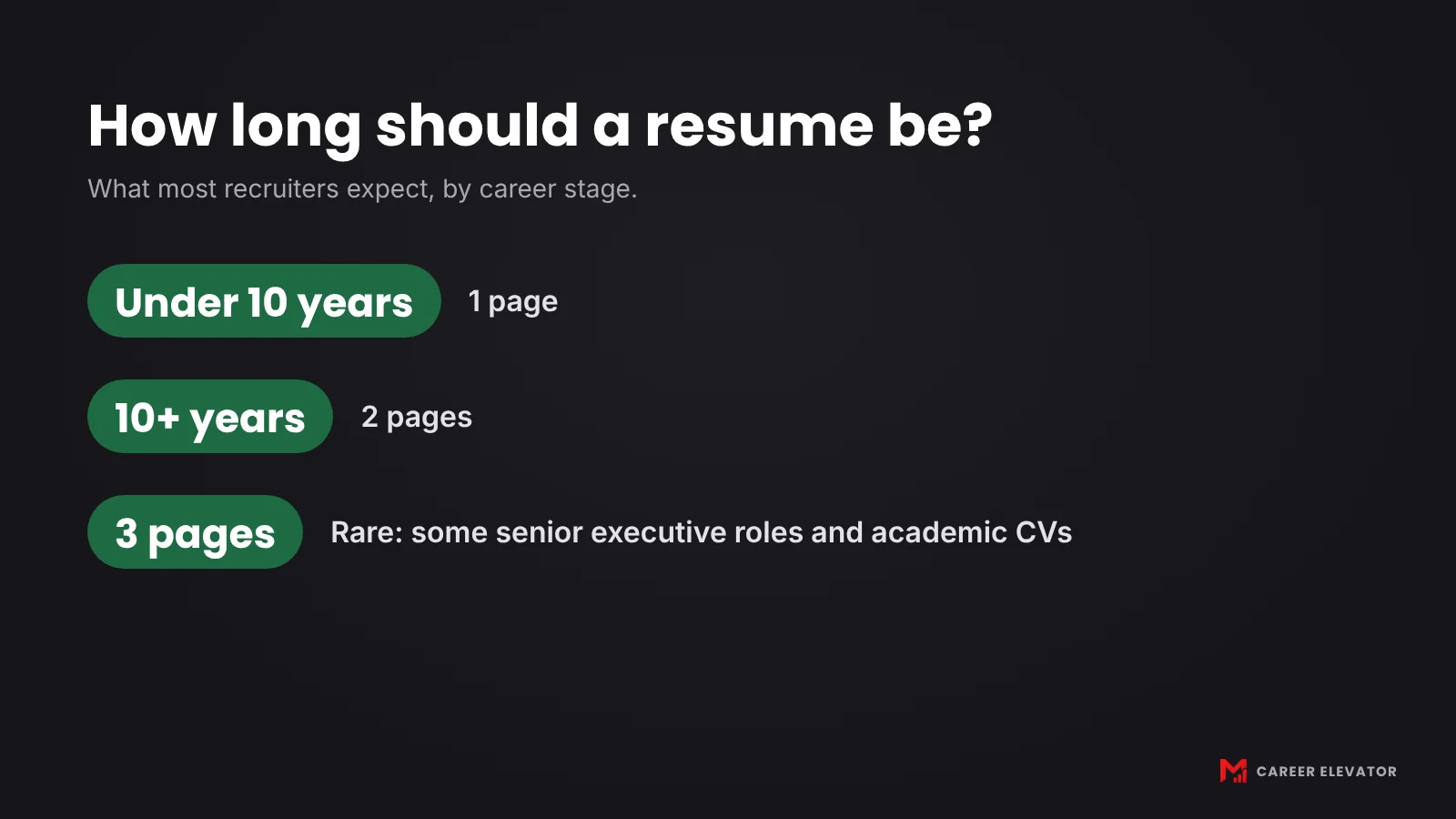
How long should a professional resume be?
For a professional with real experience behind them, two pages. Page one carries your summary and your most recent, most relevant role. Page two carries the rest of your last 10 to 15 years, then a short Earlier career section, education and anything the job specifically asks for.
How long should a resume be for 20 years experience?
Two pages, even with 20 years of experience. You don't need more space. You need to stop giving equal space to every year.
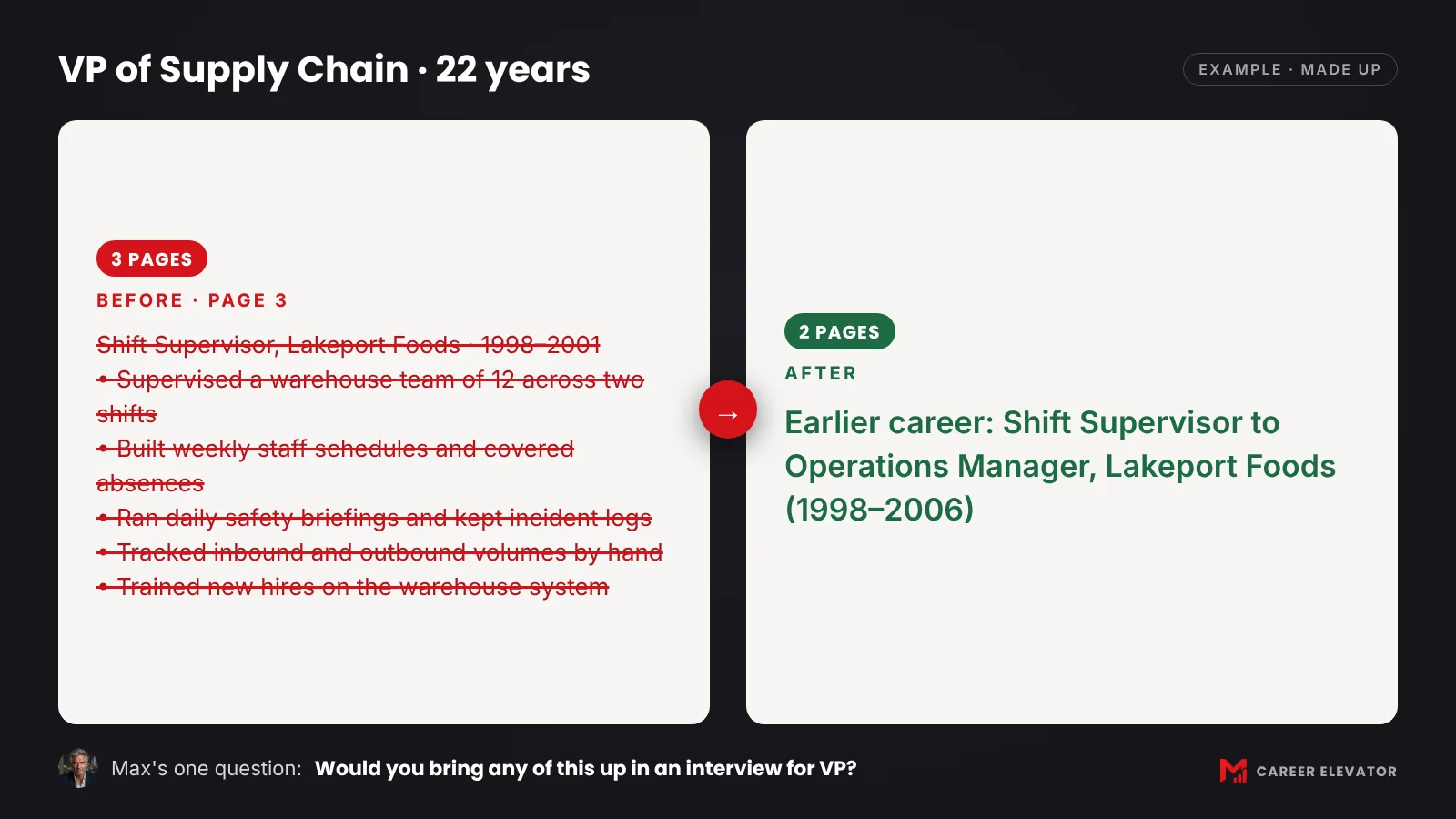
The usual approach is to keep full detail for the last 10 to 15 years and condense everything older. A role from 1998 doesn't need five bullets. It needs one line:
Earlier career: Shift Supervisor to Operations Manager, Lakeport Foods (1998–2006)
That line tells the reader where you came from without spending half a page on it. If you wouldn't bring something up in an interview for the job you want now, it doesn't need to be on the page.
How long should a resume summary be?
A resume summary should be three or four lines long, which is usually two or three sentences. Any longer and it stops being a summary and becomes a second resume sitting on top of the first.
The same goes for a professional summary. It's the same section with a different name. Three lines is enough for the formula we use everywhere:
- Known for: what people already come to you for, led by the title you want
- Proof: one result, with a number
- Next role: the job you want next, named
For a full walkthrough with before-and-after examples, see our resume summary guide.
How long should bullet points be on a resume?
Each bullet point should be one or two lines. If a bullet runs to three or four lines, the result is usually buried at the end, and many readers never get there.
A good bullet leads with what you did and what changed. Three to six bullets for your recent roles is plenty. Fewer, stronger bullets beat a long list every time. Our resume tips guide shows a simple formula for writing them, with examples.
What to cut first when your resume is too long
When a resume runs long, these are usually the easiest cuts:
- An objective statement. Replace it with a three-line summary that says what you offer.
- "References available upon request." Employers assume it.
- Your full street address. City and state are enough.
- Detailed bullets for old roles. Condense anything older than about 15 years into one line each.
- Every tool you've ever used. Keep the ones the job description mentions or clearly needs.
- Repeated bullets. If three jobs say "managed budgets", say it once, where it was biggest.
None of these are mistakes exactly. They're just taking up space your best work could use.
Three examples: shorter and stronger
Each example below was rewritten using one question from Max, the AI career coach at Maxtempo Career Elevator. All three people are made up for illustration.
Example 1: VP of Supply Chain, 22 years, three pages
Dennis's resume ran to three pages. Page three was entirely jobs from 1998 to 2006, with five bullets each.
Max's one question: "Would you bring any of this up in an interview for VP?"
His answer: "No. Not one line of it."
The fix: every role before 2006 became one Earlier career line. The resume dropped to two pages, and page one now leads with his current role.
Example 2: Director of Finance, 16 years, a nine-line summary
Before: a nine-line summary listing every system, team and skill.
Max's one question: "If they remember one thing about you, what should it be?"
Her answer: "I got month-end close from 10 days to 4."
After:
Finance director known for fast, clean month-end closes. Cut close from 10 days to 4 across three entities. Ready for a VP of Finance role.
Example 3: Senior IT Manager, 14 years, four-line bullets
Before:
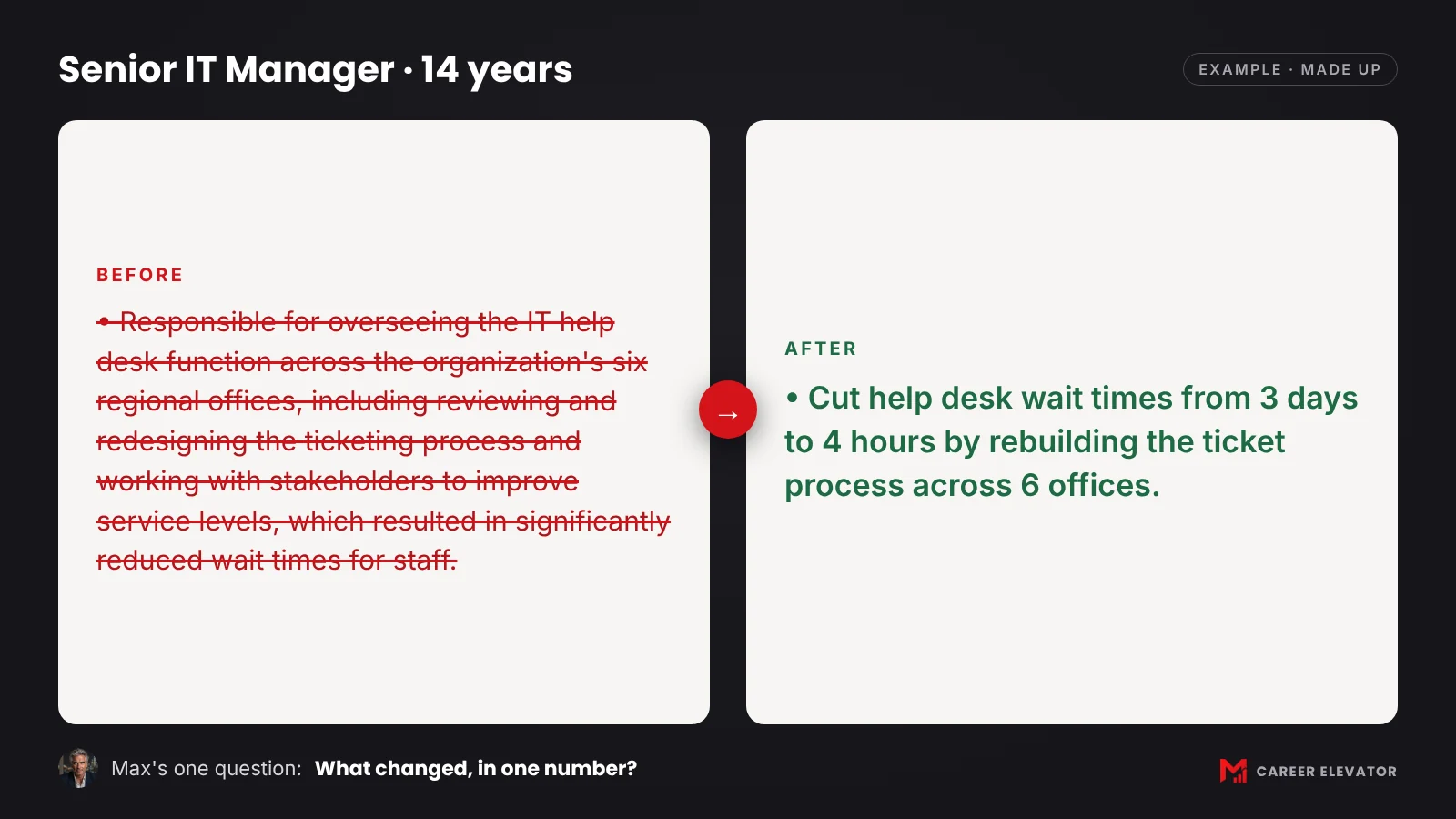
Responsible for overseeing the IT help desk function across the organization's six regional offices, including reviewing and redesigning the ticketing process, working with stakeholders to improve service levels, which resulted in significantly reduced wait times for staff.
Max's one question: "What changed, in one number?"
After:
Cut help desk wait times from 3 days to 4 hours by rebuilding the ticket process across 6 offices.
Resume length checklist
Before you send it, check that your resume:
- Is one page if you have under ten years of experience, two pages if you have more
- Puts your strongest, most relevant work on page one
- Has a summary of three or four lines
- Keeps bullets to one or two lines, result first
- Gives full detail only to the last 10 to 15 years
- Condenses older roles to one line each
- Leaves out the objective, the street address and "references available upon request"
FAQ
How long should a resume be in 2026?
The guidance hasn't changed: one page early in your career, two pages once you have about ten years of experience or more, and three only in rare senior executive or academic cases.
Is a two-page resume OK?
Yes. For experienced professionals, two pages is normal and most recruiters expect it. What matters is that page one makes the case on its own.
How long should a professional summary be on a resume?
Three or four lines, which is usually two or three sentences. That's enough to say what you're known for, prove it with one result, and name the role you want next.
Should I include jobs from 20 years ago?
Give older roles one line each under an Earlier career heading, or leave them off if they add nothing to the job you want now. Keep the detail for the last 10 to 15 years.
Does a resume have to be one page?
No. The one-page rule makes sense for students and people early in their careers. With ten years or more, squeezing onto one page usually means cutting the evidence a hiring manager needs.
Want Max to look at yours?
Cutting length is the easy part. Knowing which line is holding you back is harder. In your Free Career Audit, Max asks what you want next, finds the one vague line on your resume, asks you one sharp question about it, and rewrites that line with you.
All people, resumes and companies in this article are made up for illustration.