Career Elevator guide
Resume Tips: 7 Fixes for Experienced Professionals
Resume tips for people 10+ years in: results not duties, a 3-part bullet formula, stronger action verbs and transferable skills, with example rewrites.
In this article
- 1. Write the top third for the job you want next
- 2. Put accomplishments on your resume, not duties
- 3. Use the resume bullet point formula
- 4. Start with strong resume action verbs
- 5. Show transferable skills on your resume
- 6. Keep the detail to your last 10 to 15 years
- 7. Cut the buzzwords
- Three resume lines, rewritten
- Resume tips checklist
- FAQ
- Want Max to look at yours?
Resume tips written for graduates won't fix a resume with twenty years on it.
Early-career resumes struggle because there isn't enough on them. Experienced resumes struggle for the opposite reason: there's too much of the wrong thing. Duties instead of results. Verbs that hide what you did. Job titles and jargon that only make sense inside your current company. Each one makes a hiring manager work harder to see what you'd do for them, and most won't put in the effort.
Here are seven resume tips for people 10 to 25 years into their careers, each shown on a real-looking resume line.
1. Write the top third for the job you want next
The top third of your resume should be written for your next job, not your last one. It's what gets read first, so it has to answer the question every reader starts with: where does this person fit?
The top third is your summary and your most recent role. Put the title you're aiming for in the summary, and move your most relevant achievement to the first bullet of your current job. You don't need to rewrite your whole resume for every application. Tailoring the top third usually does most of the work.
2. Put accomplishments on your resume, not duties
Accomplishments show what changed because you were there. Duties only describe the job. Compare these:
Duty:
Responsible for employee relations and performance management for 400 employees.
Accomplishment:
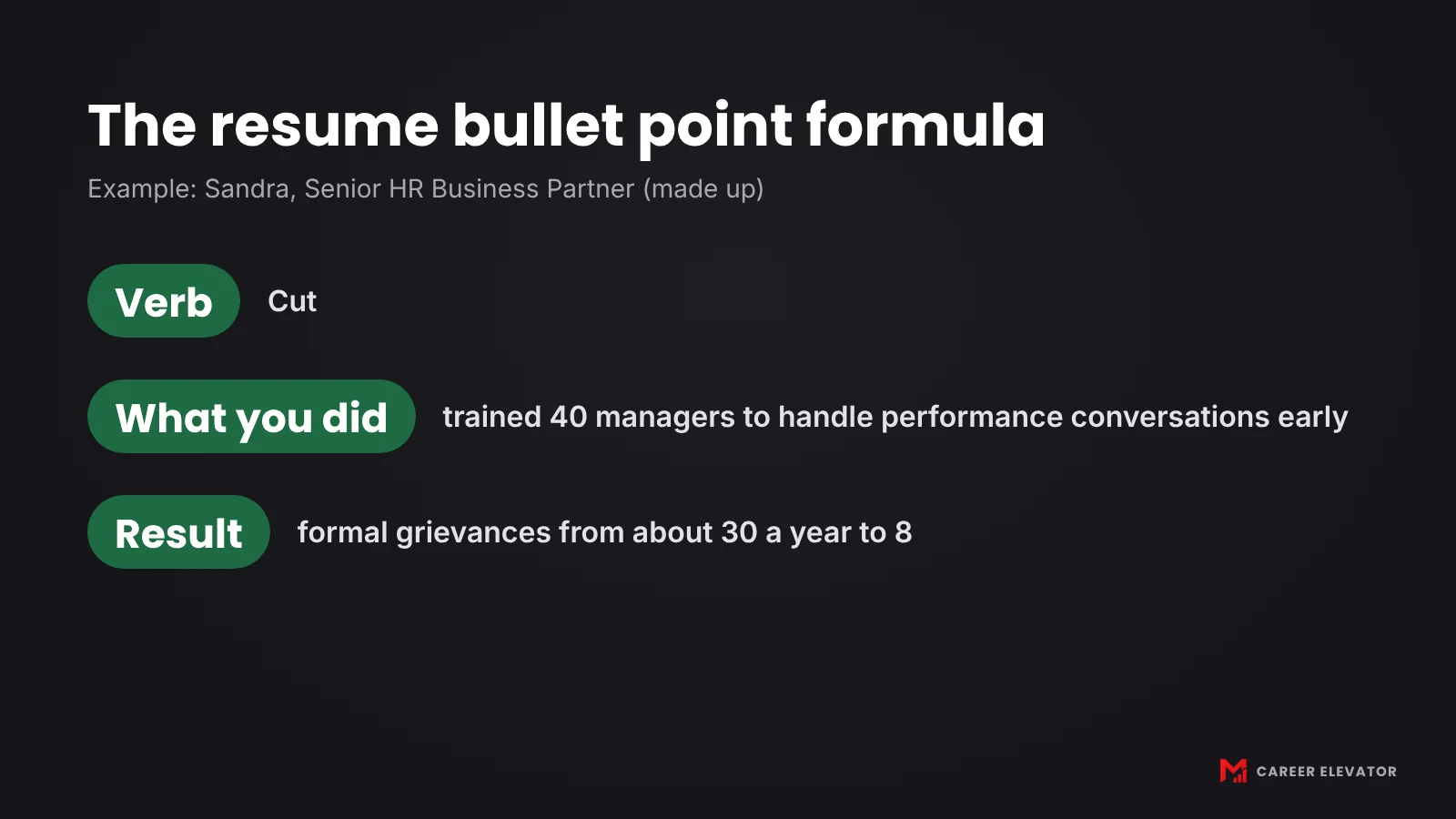
Cut formal grievances from about 30 a year to 8 by training 40 managers to handle performance conversations early.
The first line could belong to anyone in the role. The second could only belong to the person who did it. To find your accomplishments, ask one question about every duty on your resume: what got better because I handled it?
3. Use the resume bullet point formula
Every strong resume bullet point has three parts:
- Verb: what you did, in one strong word
- What you did: specific enough to picture
- Result: what changed, ideally with a number
Keep each bullet to one or two lines and three to six bullets for recent roles. If the result only shows up in line four, move it to the front.
4. Start with strong resume action verbs
Resume action verbs should say what you did, not what you were near. Some verbs quietly turn you into a passenger on your own projects:
| Instead of | Try | |---|---| | Helped | Led, drove, delivered | | Worked on | Built, designed, rebuilt | | Assisted with | Supported (if that's honest), coordinated, ran | | Participated in | Contributed, represented, negotiated | | Responsible for | Managed, cut, grew, launched |
Only use a stronger verb if it's true. If you supported a project rather than led it, say so and show what your part achieved. Honest and specific beats inflated every time.
5. Show transferable skills on your resume
Transferable skills only transfer if you translate them. When you change direction, a hiring manager reads your resume in the language of their world, not yours.
Angela (made-up example) spent 18 years in retail and wants to move into operations. Her resume said:
Managed a busy retail store.
An operations director reads that and sees a shop. Rewritten in their language:
Ran inventory, staffing and loss prevention for a $12M store with 60 staff; cut shrink by a third in two years.
Same job. Now it reads as an operation. The trick is to describe the parts of your work that the new field cares about, using the words it uses.
6. Keep the detail to your last 10 to 15 years
Older roles can be condensed to a line each. Most recruiters expect an experienced resume to run to two pages, and it gets there by focusing on recent work, not by shrinking the font. Our guide on how long a resume should be covers what to cut.
7. Cut the buzzwords
Results-driven, dynamic, proven track record, team player: these feel safe, but they turn up on so many resumes that readers skim past them. Replace each one with evidence. If you're results-driven, show a result. See our resume summary guide for the three-line fix.
Three resume lines, rewritten
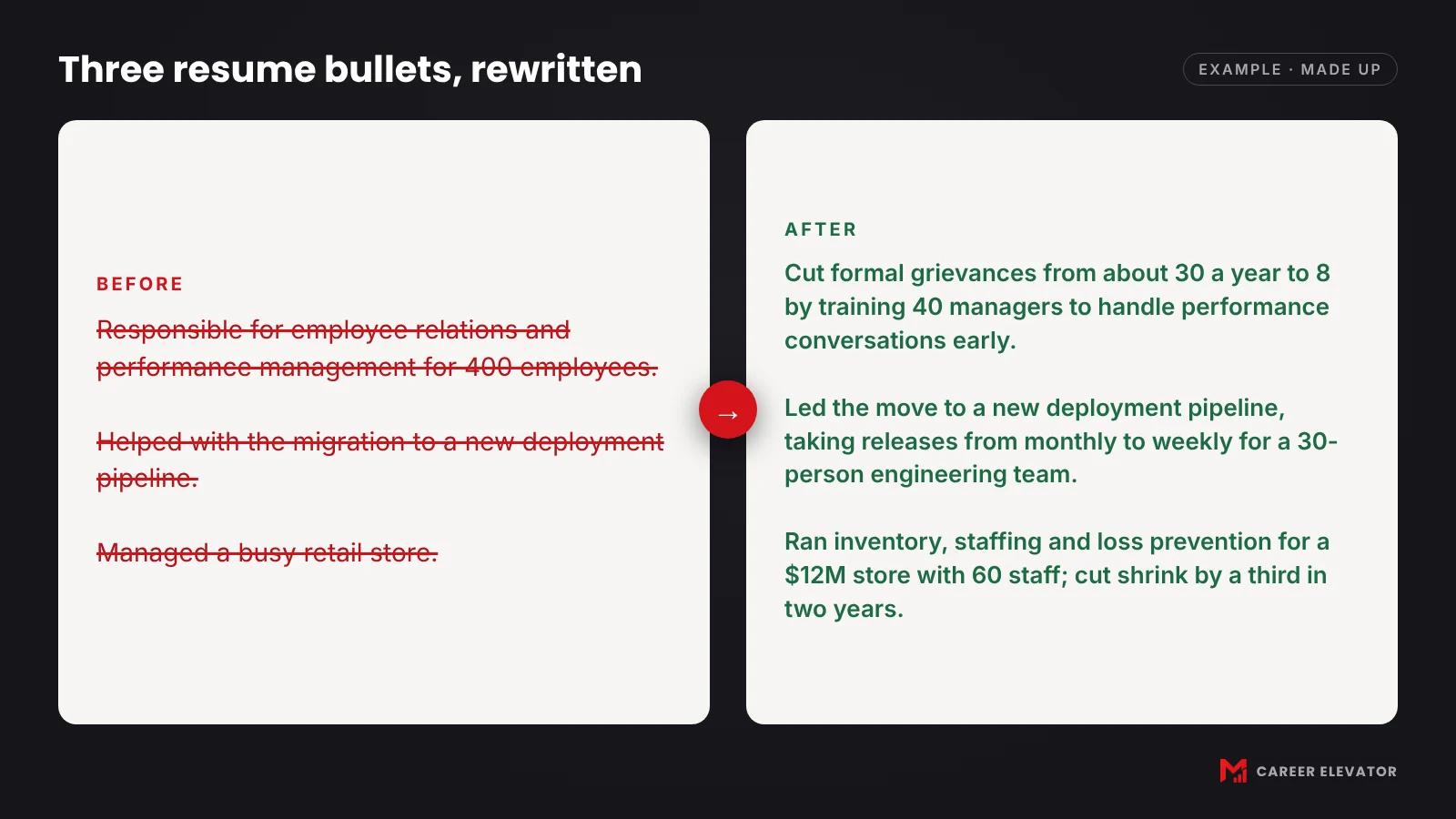
Max, the AI career coach at Maxtempo Career Elevator, rewrote each of these after asking one question. The people are made up for illustration.
Sandra, Senior HR Business Partner, 15 years
- Before: Responsible for employee relations and performance management for 400 employees.
- Max's one question: "What got better because you handled it?"
- After: Cut formal grievances from about 30 a year to 8 by training 40 managers to handle performance conversations early.
Luis, Engineering Manager, 13 years
- Before: Helped with the migration to a new deployment pipeline.
- Max's one question: "Which part was yours?"
- After: Led the move to a new deployment pipeline, taking releases from monthly to weekly for a 30-person engineering team.
Angela, Store Manager moving into operations, 18 years
- Before: Managed a busy retail store.
- Max's one question: "What would an operations director recognize in your job?"
- After: Ran inventory, staffing and loss prevention for a $12M store with 60 staff; cut shrink by a third in two years.
Resume tips checklist
- The top third names the job you want next
- Every bullet leads with a strong, honest verb
- Most bullets include a result, with a number where you can
- Bullets are one or two lines, three to six per recent role
- Your experience is described in the language of the field you're applying to
- Full detail covers the last 10 to 15 years
- No buzzwords that could describe anyone
FAQ
What are the best resume tips for experienced professionals?
Lead with results instead of duties, start each bullet with a strong verb, add one number per bullet where you can, translate your experience into the language of the job you want, and keep the detail to your last 10 to 15 years.
How many bullet points should each job have on a resume?
Three to six for your recent roles is plenty, each one or two lines long. Older roles need fewer, and anything from more than about 15 years ago can be a single line.
What are good action verbs for a resume?
Verbs that say what you did and what changed: led, built, cut, grew, launched, negotiated, rebuilt, delivered. Avoid verbs that hide your part, like helped, worked on, assisted with and participated in.
How do I show transferable skills on a resume?
Describe what you actually did in the words the new field uses, and attach a result. "Managed a busy store" becomes "Ran inventory, staffing and loss prevention for a $12M store; cut shrink by a third."
Should I tailor my resume for every job?
Tailor the top third: the target title in your summary and the order of the bullets in your most recent role. The rest of your resume can usually stay the same.
Want Max to look at yours?
Tips are easy to read and hard to apply to your own resume. In your Free Career Audit, Max asks what you want next, finds the one vague line on your resume, asks you one sharp question about it, and rewrites that line with you.
All people, resumes and companies in this article are made up for illustration.